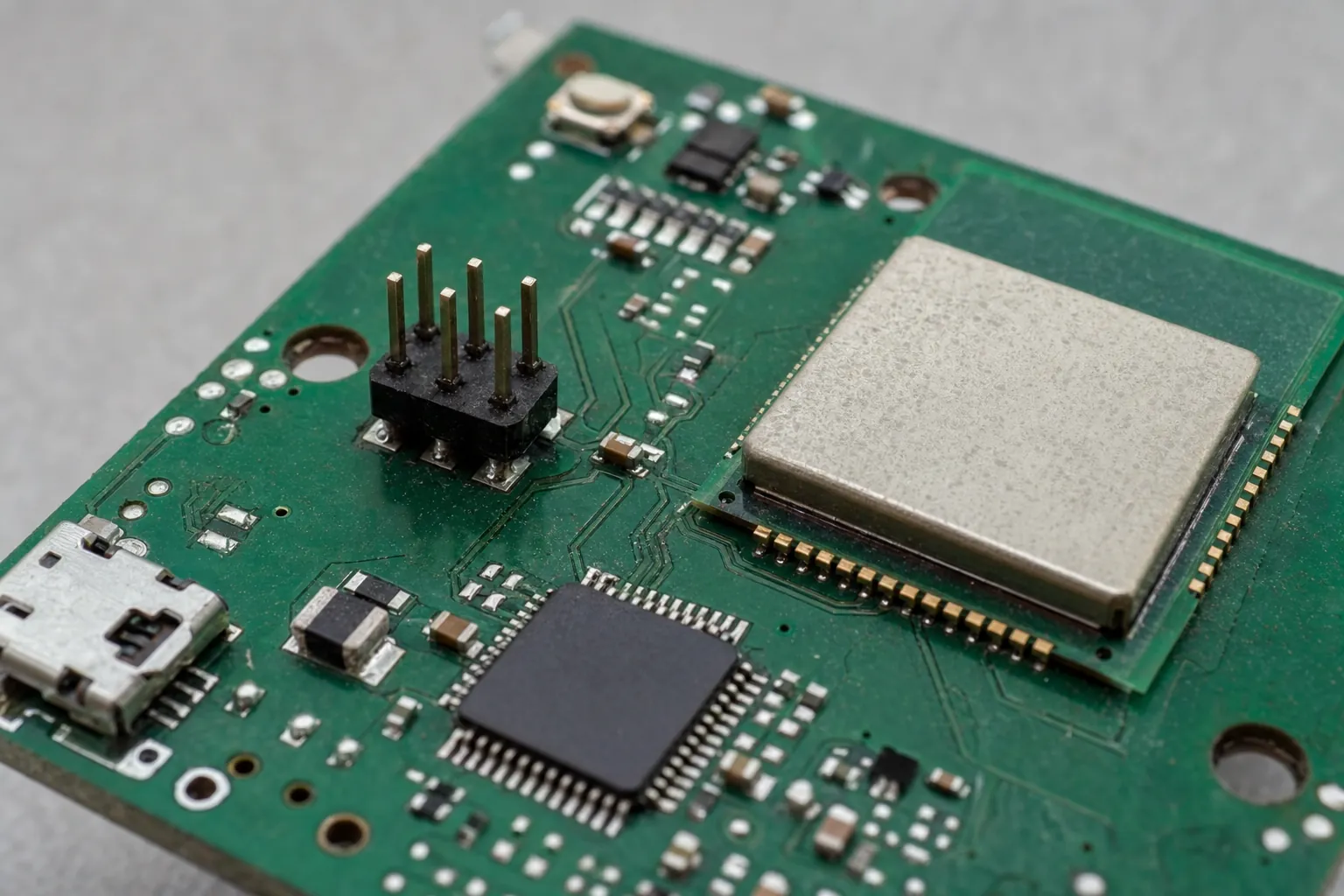
Component categories
| Component | Category | Class |
|---|---|---|
| Wi-Fi, Bluetooth, Zigbee, Ethernet, USB or Fieldbus interface card, controller or module | Network interfaces | I (point 10) |
| Microcontroller with security functions such as encryption, secure key storage or a trusted execution environment | Microcontrollers with security functions | I (point 14) |
| Microprocessor with security functions | Microprocessors with security functions | I (point 13) |
| ASIC or FPGA with security functions | ASICs and FPGAs with security functions | I (point 15) |
| UEFI firmware, single-stage or multi-stage boot loader | Boot managers | I (point 8) |
| Operating system, including a real-time OS | Operating systems | I (point 11) |
| Tamper-resistant microcontroller or microprocessor designed for AVA_VAN level 2 or 3 | Tamper-resistant microcontrollers, Tamper-resistant microprocessors | II (points 3 and 4) |
| Secure element, TPM, eUICC, smartcard designed for at least AVA_VAN.4 | Smartcards and secure elements | Critical (Annex IV, point 3) |
| Sensor, display, power or other component with no listed core functionality | Not listed | Default |
The security-function test matters for chips. The Commission's descriptions cover chips whose security functions aim to secure other products, networks or services beyond the chip itself, such as a secure boot chain or secure communication interfaces. The tamper-resistant and secure element categories are defined by AVA_VAN levels from the Common Criteria (Implementing Regulation (EU) 2025/2392, recital 8).
Your class does not pass to the OEM
Article 7(1) says integrating an important product does not by itself make the host product important. The implementing regulation repeats this (recitals 3 to 5), and the Commission's guidance gives the smartphone example: it integrates an operating system but is not an operating system product (Example 58). Your OEM customers classify their devices by their own core functionality. Your module needs its own conformity assessment, and theirs covers the device as a whole (Commission guidance, point 147).
What OEM customers will ask you for
OEMs must exercise due diligence so that components they integrate do not compromise their product (Article 13(5)), and they consider the support periods of integrated components that provide core functions when they set their own (Article 13(8)). When they find a vulnerability in your component, they must report it to you and share any fix (Article 13(6)). In practice that means your customers will ask for:
- Conformity evidenceYour EU declaration of conformity and CE marking for components placed on the market separately.
- SBOMA machine-readable SBOM covering at least top-level dependencies (Annex I, Part II, point 1).
- Support periodThe end date of security support, at least five years unless the expected use is shorter (Article 13(8)).
- Vulnerability contactA coordinated vulnerability disclosure policy and a contact address (Annex I, Part II, points 5 and 6).
Special cases
- Designs older than the CRAA microcontroller designed before the CRA can be placed on the market after 11 December 2027 without redesign if the risk assessment shows its existing measures address the risks (Commission guidance, Example 12).
- AssemblersA company that builds bought modules and its own firmware into a new product places a new product and is its manufacturer (Example 51).
- Vehicle-only partsComponents designed exclusively for vehicles under Regulation (EU) 2019/2144 or 168/2013 are outside the CRA. Generic components, or components sold through channels open to the public, are in scope (points 244 to 246).
- Spare partsIdentical replacement parts made to the same specification are excluded (Article 2(6)).
- Licensed source codeSupplying source code as a product, even for further adaptation, is placing it on the market (Example 7).
Sample component pack
- Category
- Important, Class IAnnex III, point 10
- Route
- Module B+C or Module H, unless harmonised standards are applied in fullArt. 32(2)
- SBOM
- CycloneDX, firmware and driver, top-level dependenciesAnnex I, Part II(1)
- Support period
- End date stated in the datasheet and declaration packArt. 13(8)
- OEM device class
- Unaffected by integrating this moduleArt. 7(1)
- Vulnerability contact
- Published CVD policy and security contactAnnex I, Part II(5), (6)
Common questions
If we sell a Class I Wi-Fi module, is our customer's thermostat Class I?
No. Integrating a Class I component does not by itself change the host product's class (Article 7(1)). The thermostat is classified by its own core functionality.
Do chips without security functions count?
A chip placed on the market separately with a data connection use can still be a product in the default category. Points 13 to 15 apply only to chips with security-related functionalities.
Are automotive-only parts in scope?
Not if they are designed exclusively for vehicles covered by Regulation (EU) 2019/2144 or 168/2013 and sold through automotive supply channels (Commission guidance, points 244 to 246).
Sources
- Regulation (EU) 2024/2847 (Cyber Resilience Act), Official Journal text
- Commission Implementing Regulation (EU) 2025/2392, technical descriptions of important and critical products
- Commission guidance on the application of the CRA, C/2026/6013 (OJ C, 17 November 2026)
- Commission Delegated Regulation (EU) 2025/1535 (exclusion of L-category vehicles)