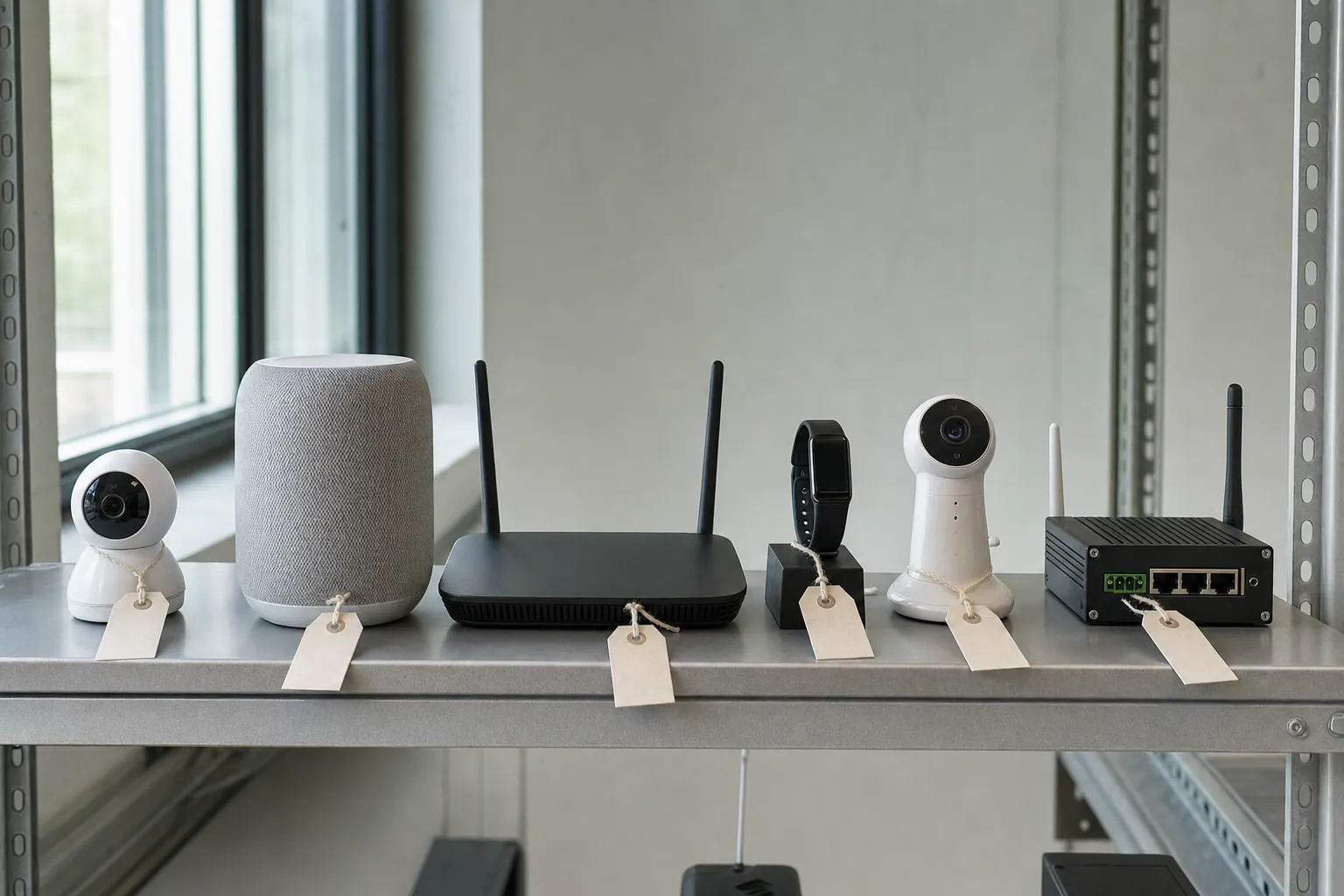
Pick your product type
Each page below answers the same questions for one kind of US maker: which Annex III or IV categories usually apply, which conformity route follows, what overlaps with rules you may already follow, and what to do first. The class of a product depends on its core functionality as the Commission describes it in Implementing Regulation (EU) 2025/2392, not on its marketing or on the components inside it.
| Product type | Typical classification | Guide |
|---|---|---|
| Smart home devices | Locks, cameras, baby monitors and alarms are Class I; smart speakers with a voice assistant are Class I; most other smart home devices are default | Read the guide |
| Wearables | Health-monitoring wearables and wearables for children under 14 are Class I, unless they are medical devices | Read the guide |
| Industrial IoT and OT | Mostly default; managed switches, routers, network management and Fieldbus interfaces are Class I; firewalls and IDS are Class II | Read the guide |
| Routers and networking | Routers, internet modems, switches and access points are Class I; firewalls and IDS/IPS are Class II | Read the guide |
| Consumer electronics with apps | Default unless the core functionality is listed; the device and its companion app form one product | Read the guide |
| SaaS and cloud backends | SaaS on its own is NIS2 territory; cloud software a product needs to work is part of that product | Read the guide |
| Open-source projects and companies | Not in scope unless monetised; stewards have a lighter regime under Article 24 | Read the guide |
| Chips, modules and firmware for OEMs | Network modules, secure MCUs and MPUs, boot loaders and operating systems are Class I; tamper-resistant chips Class II; secure elements critical | Read the guide |
| B2B and enterprise software | Installed software is in scope; security categories such as VPN, SIEM and PKI are Class I; hypervisors and firewalls Class II | Read the guide |
| Medical, vehicles, aviation, marine | Excluded where the sector law applies; generic components and wellness wearables are not | Read the guide |
What every US maker shares
- ScopeThe CRA covers hardware and software whose intended or reasonably foreseeable use includes a data connection, made available on the EU market in the course of a commercial activity, paid or free (Articles 2(1) and 3(22)). Where your company is based does not matter.
- Reporting nowSince 11 September 2026, manufacturers must report actively exploited vulnerabilities and severe incidents through ENISA's Single Reporting Platform: an early warning within 24 hours, a notification within 72 hours and a final report (Article 14). This covers products already on the market (Article 69(3)).
- Full applicationFrom 11 December 2027, new units must meet the essential requirements in Annex I, carry the CE marking and come with technical documentation and an EU declaration of conformity (Article 71(2)).
- Support and SBOMA support period of at least five years unless the product is expected to be used for less time (Article 13(8)), and a software bill of materials covering at least top-level dependencies (Annex I, Part II, point 1).
If you make more than one kind of product
Classify each product on its own. A company can sell a default-category sensor, a Class I gateway and a Class II firewall at the same time, and each needs its own route. Where you sell modules of a suite separately, the Commission treats each module as a product classified by its own core functionality (Commission guidance, point 145). The class checker walks through one product at a time, and the product class list gives the official description of all 26 categories.
Conformity routes at a glance
| Class | Conformity route | Article |
|---|---|---|
| Default | Self-assessment under Module A, or by choice a third-party route | 32(1) |
| Important, Class I | Module B+C or Module H with a notified body, unless harmonised standards, common specifications or a certification scheme at "substantial" are applied in full | 32(2) |
| Important, Class II | Module B+C, Module H, or a certification scheme at "substantial" where available | 32(3) |
| Critical | A European cybersecurity certificate where a delegated act under Article 8(1) requires one; otherwise the Class II routes | 8(1), 32(4) |
Common questions
Does the CRA apply to US companies with no EU office?
Yes, if they make products available on the EU market. The obligations fall on the manufacturer wherever it is based. EU importers and distributors must check your CE marking and documentation before they sell (Articles 19 and 20).
Where do I start if I am not sure of my class?
Run the class checker, then read the guide for your product type. If your product sits between two categories, the technical descriptions in Implementing Regulation (EU) 2025/2392 decide.
Sources
- Regulation (EU) 2024/2847 (Cyber Resilience Act), Official Journal text
- Commission Implementing Regulation (EU) 2025/2392, technical descriptions of important and critical products
- Commission guidance on the application of the CRA, C/2026/6013 (OJ C, 17 November 2026)
- European Commission, CRA reporting obligations