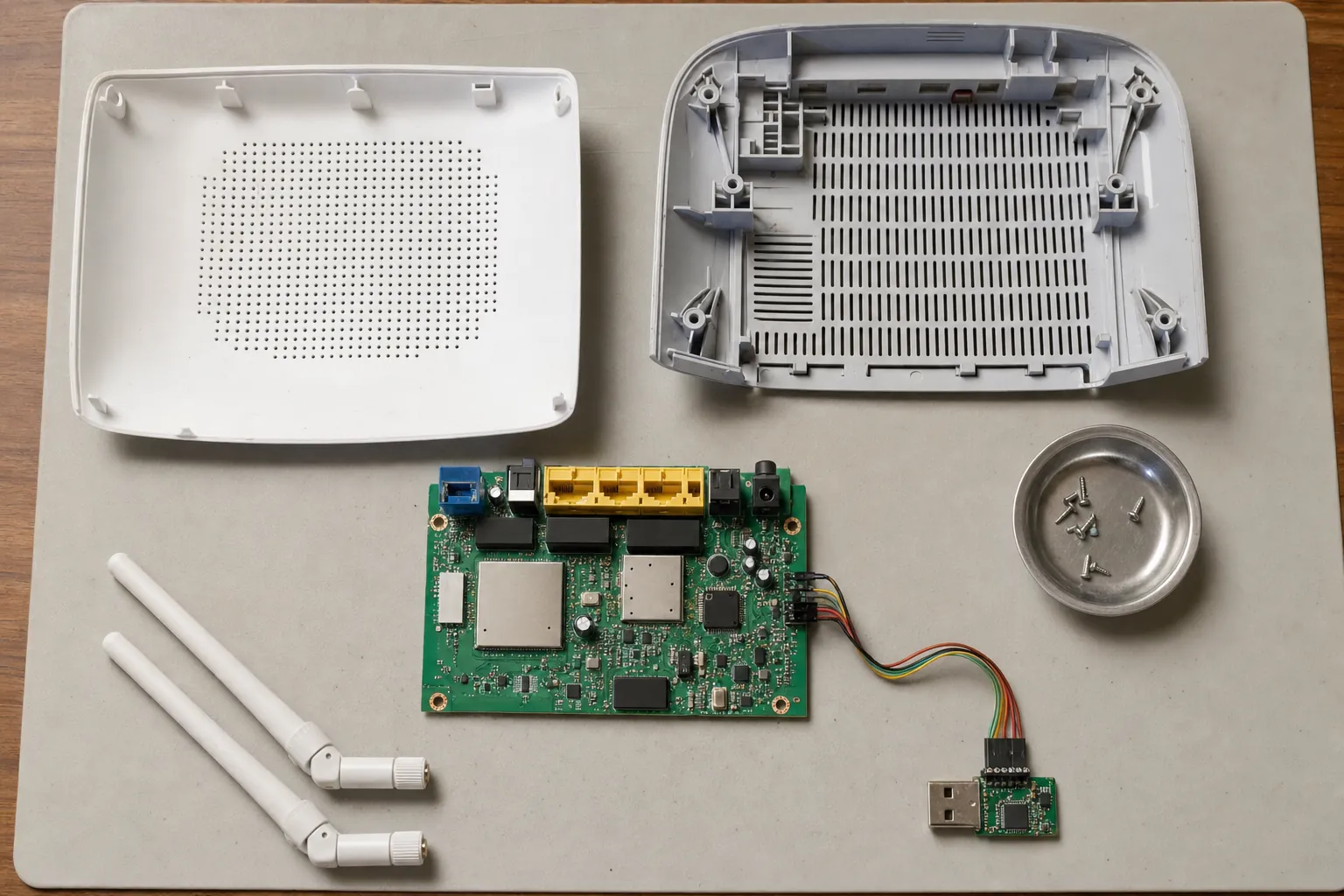
What point 12 covers
Implementing Regulation (EU) 2025/2392 gives each product type in point 12 its own description and examples.
| Product | What the Commission includes | Class |
|---|---|---|
| Routers | Wired and wireless routers, virtual routers, routers with or without modems | I (point 12) |
| Modems intended for connection to the internet | Fibre, DSL, cable (DOCSIS), satellite and cellular modems | I (point 12) |
| Switches | Managed, smart and multilayer switches, virtual security switches, programmable SDN switches, and bridges such as wireless access points | I (point 12) |
| Network interface cards and adapters | Wi-Fi, Ethernet, USB, Bluetooth, Zigbee and Fieldbus adapters, virtual interfaces | I (point 10) |
| Network management and SDN controllers | End-to-end and configuration management systems | I (point 6) |
| VPN gateways | VPN clients, servers and gateways | I (point 5) |
| Firewalls, intrusion detection and prevention systems | Network and application firewalls, anti-spam gateways, network and host-based IDS and IPS | II (Class II, point 2) |
A router with a firewall is still a router
A product has one core functionality for classification (Commission guidance, point 144). In the Commission's Example 63, a router that integrates a firewall is classified as a router. The manufacturer's risk assessment covers both functions, it applies a harmonised standard for the router's core functionality and can use another standard, such as the one for firewalls, for the extra function. On that basis it may use internal control for the product as a whole (point 152). A dedicated firewall appliance, by contrast, is Class II and always needs a third-party route.
The route today
| Class | Conformity route | Article |
|---|---|---|
| Default | Self-assessment under Module A, or by choice a third-party route | 32(1) |
| Important, Class I | Module B+C or Module H with a notified body, unless harmonised standards, common specifications or a certification scheme at "substantial" are applied in full | 32(2) |
| Important, Class II | Module B+C, Module H, or a certification scheme at "substantial" where available | 32(3) |
| Critical | A European cybersecurity certificate where a delegated act under Article 8(1) requires one; otherwise the Class II routes | 8(1), 32(4) |
No CRA harmonised standard had been cited in the Official Journal as of 23 November 2026. Under the amended standardisation request of 10 November 2026, the standards for the Annex III and IV categories are due by 31 January 2027, so citation before 11 December 2027 is possible but not certain. When we checked NANDO on 23 November 2026, it listed no notified body under the CRA.
Rules you may already follow
- Radio Equipment DirectiveRadio equipment that can communicate over the internet has had to meet the cybersecurity requirements of Delegated Regulation (EU) 2022/30 since 1 August 2025, with points (e) on personal data also covering childcare equipment, toys and wearables. The harmonised standards EN 18031-1, -2 and -3 are cited with restrictions, including one that removes the presumption of conformity where a user may skip setting a password. Delegated Regulation (EU) 2026/339 repeals 2022/30 from 11 December 2027, when the CRA takes over, and a RED type-examination certificate can be relied on for the risks it covers until 11 June 2028 at the latest (Article 69(1); Commission guidance, points 247 to 249). See EN 18031.
- GermanyWhen the Bundestag passed Germany's CRA implementation act on 15 October 2026, naming the BSI as market surveillance authority, it also passed a resolution asking the BSI to check routers first.
- NIS2 customersTelecom operators and other NIS2 entities buying your equipment have supply chain duties under NIS2 Article 21. The CRA is meant to help them meet those duties (CRA recital 24).
What to do first
- Classify each SKURouter, modem, switch, access point, mesh node, and any separate firewall or management software. A single product has one core functionality.
- Fix default credentials and updatesSecure by default configuration, reset to original state, and security updates with automatic installation as the default where applicable (Annex I, Part I, point 2(b) and (c)).
- Set up reportingArticle 14 applies now, including to routers already deployed. Routers are a common target, so test the 24-hour path.
- Book the third-party stepPlan Module B+C or H with a notified body unless a harmonised standard is cited and applied in full before your launch.
- Keep updates availableEach security update must stay available for at least 10 years or the rest of the support period, whichever is longer (Article 13(9)).
Sample scoping sheet
- Core functionality
- Routing between home network and internet, with built-in firewallGuidance, Example 63
- Category
- Important, Class IAnnex III, point 12
- Route
- Module B+C or Module H; Module A only with harmonised standards applied in fullArt. 32(2)
- Radio rules
- RED delegated act and EN 18031-1 until 10 December 2027Reg. (EU) 2022/30
- Defaults
- Unique credentials, automatic security updates on by default with opt-outAnnex I, Part I(2)(b), (c)
- Update archive
- Each security update kept available at least 10 yearsArt. 13(9)
Common questions
Is a mesh Wi-Fi node a Class I product?
Yes, where its core functionality is routing or acting as a wireless access point. The Commission lists wireless access points as bridges within the switches description in point 12.
Can we self-assess a router under Module A?
Only if you apply in full a harmonised standard, common specifications or a certification scheme at "substantial" that covers the router's core functionality risks (Article 32(2); Commission guidance, point 149). No CRA standard was cited as of November 2026.
Does an ISP-supplied modem fall under the CRA?
Modems intended for connection to the internet are Class I whoever sells them. Who carries the manufacturer's duties depends on whose name or trademark the modem is placed on the market under (Article 3(13) and Article 21).
Sources
- Regulation (EU) 2024/2847 (Cyber Resilience Act), Official Journal text
- Commission Implementing Regulation (EU) 2025/2392, technical descriptions of important and critical products
- Commission guidance on the application of the CRA, C/2026/6013 (OJ C, 17 November 2026)
- Commission Delegated Regulation (EU) 2022/30 (cybersecurity requirements for radio equipment)
- Commission Delegated Regulation (EU) 2026/339 (repeal of 2022/30 from 11 December 2027)
- Commission Implementing Decision (EU) 2025/138 (EN 18031 cited with restrictions)
- Commission Implementing Decision C(2026) 7861 amending the CRA standardisation request
- European Commission, Single Market Compliance Space: notified bodies (NANDO)
- Deutscher Bundestag, CRA implementation act passed 15 October 2026 (German)
- Directive (EU) 2022/2555 (NIS2)