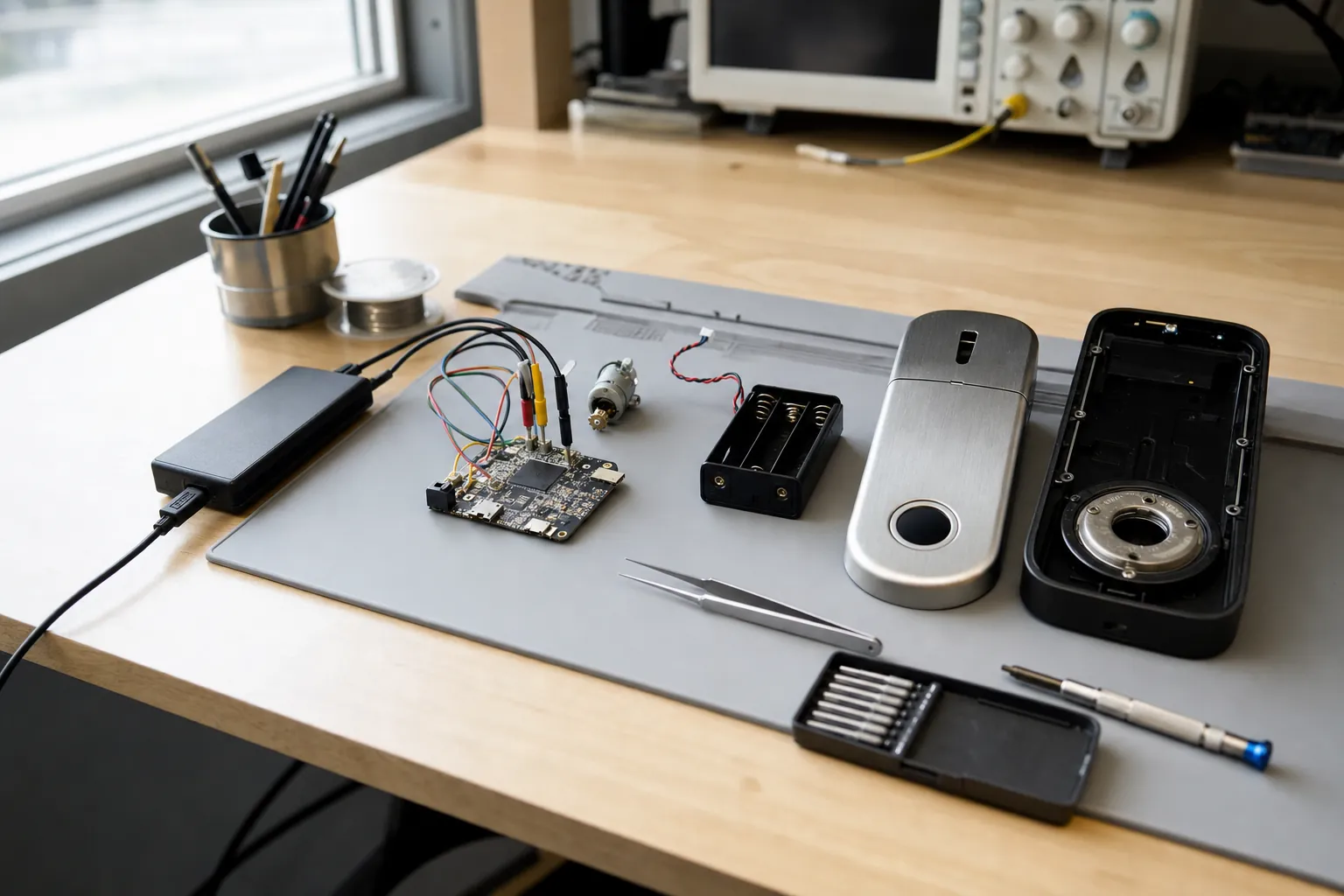
Device, app and cloud as one product
A product with digital elements is the software or hardware together with its remote data processing solutions (Article 3(1)). The Commission's guidance turns that into a practical rule: software needed to operate, configure, control or use a device is part of the product, even if it arrives separately through an app store or a download link (point 25). Its examples are a network printer whose drivers come from the maker's website (Example 8) and a fitness wearable whose app displays the data (Example 9). Recital 11 adds that a mobile app's API or database, provided through a service the manufacturer developed, is remote data processing within the CRA.
An app sold or distributed on its own is a product in its own right where it installs and runs on the user's device (Commission guidance, Example 3). A web app used only in a browser is not a product, unless it supports the functionality of one (Example 5).
Which class applies
| Product | Category | Class |
|---|---|---|
| Smart speaker with a general purpose virtual assistant | Smart home virtual assistants | I (point 16) |
| Security camera, smart lock, baby monitor, alarm | Smart home security products | I (point 17) |
| Connected toy that speaks, films or tracks location | Connected toys | I (point 18) |
| Health-monitoring wearable, or wearable for children under 14 | Health and children's wearables | I (point 19) |
| Smartphone, tablet, laptop | Not an operating system product just because it runs one (Example 58) | Default unless another listed category applies |
| Smart TV, printer, robot vacuum, smart appliance, game console | Not listed in Annex III or IV | Default |
Support periods and updates
Consumer products are where support periods are most visible. The support period must reflect how long the product is expected to be in use and be at least five years, unless it is expected to be used for less (Article 13(8)). The end month and year must be shown clearly at the time of purchase, and where feasible users are told when support ends (Article 13(19)).
- Security updatesSeparate from functionality updates where technically feasible, free of charge, and with automatic installation as the default where applicable, with an opt-out (Annex I, Part I, point 2(c); Part II, points 2 and 8).
- Update archiveEach security update stays available for at least 10 years or the rest of the support period, whichever is longer (Article 13(9)).
- Feature updatesA software update that adds features can be a substantial modification. In the Commission's robot vacuum example, the support period still follows the original expected use time (Example 54).
- SmartphonesThe Commission's Example 52 describes a smartphone with a declared support period during which the maker releases updates and new operating system versions.
Rules you may already follow
- Radio Equipment DirectiveRadio equipment that can communicate over the internet has had to meet the cybersecurity requirements of Delegated Regulation (EU) 2022/30 since 1 August 2025, with points (e) on personal data also covering childcare equipment, toys and wearables. The harmonised standards EN 18031-1, -2 and -3 are cited with restrictions, including one that removes the presumption of conformity where a user may skip setting a password. Delegated Regulation (EU) 2026/339 repeals 2022/30 from 11 December 2027, when the CRA takes over, and a RED type-examination certificate can be relied on for the risks it covers until 11 June 2028 at the latest (Article 69(1); Commission guidance, points 247 to 249).
- US Cyber Trust MarkThe FCC's U.S. Cyber Trust Mark is a voluntary label for wireless consumer IoT products, with a QR code linking to a registry (47 CFR 8.203). The FCC says it will announce when the program is ready to accept applications for products to bear the label; it had not done so by 23 November 2026. It is a separate US program and does not show conformity with the CRA.
- AI featuresVoice assistants and other AI features may bring AI Act duties. For high-risk AI systems, CRA conformity can demonstrate the AI Act's cybersecurity requirement (CRA Article 12). See CRA vs the AI Act.
What to do first
- Draw the product boundaryList the device, app, firmware, drivers and cloud functions that the product needs, and treat them as one product.
- ClassifyMost consumer electronics are default. Check speakers, security devices, toys and wearables against points 16 to 19.
- Set up reportingArticle 14 has applied since 11 September 2026 to products already sold in the EU.
- Decide the support periodBase it on expected use and show the end date at purchase.
- Plan updatesAutomatic security updates where applicable, kept available for at least 10 years.
Sample scoping sheet
- Product boundary
- Vacuum firmware, phone app and maps service, assessed togetherGuidance, point 25
- Category
- Default, core functionality not listedAnnex III, IV
- Route
- Module A self-assessmentArt. 32(1)
- Support period
- Matches expected use time, at least five years, end date shown at purchaseArt. 13(8), 13(19)
- Updates
- Automatic security updates on by default, with opt-outAnnex I, Part I(2)(c)
- Reporting
- Applies now through ENISA's Single Reporting PlatformArt. 14
Common questions
Is a smartphone an operating system product under the CRA?
No. The Commission says a smartphone integrates an operating system but has a different core functionality, so it is not in the operating systems category on that basis (Commission guidance, Example 58).
Do default-category products need a notified body?
No. They can self-assess under Module A (Article 32(1)). They still need to meet every applicable Annex I requirement, carry the CE marking and have technical documentation.
Is our website in scope?
Not if it only presents information. A website is in scope as remote data processing only where it supports a function of the product, such as an authentication portal the device needs (Commission guidance, point 194).
Sources
- Regulation (EU) 2024/2847 (Cyber Resilience Act), Official Journal text
- Commission Implementing Regulation (EU) 2025/2392, technical descriptions of important and critical products
- Commission guidance on the application of the CRA, C/2026/6013 (OJ C, 17 November 2026)
- Commission Delegated Regulation (EU) 2022/30 (cybersecurity requirements for radio equipment)
- Commission Delegated Regulation (EU) 2026/339 (repeal of 2022/30 from 11 December 2027)
- FCC, U.S. Cyber Trust Mark
- Regulation (EU) 2026/1744 amending the AI Act (high-risk dates)