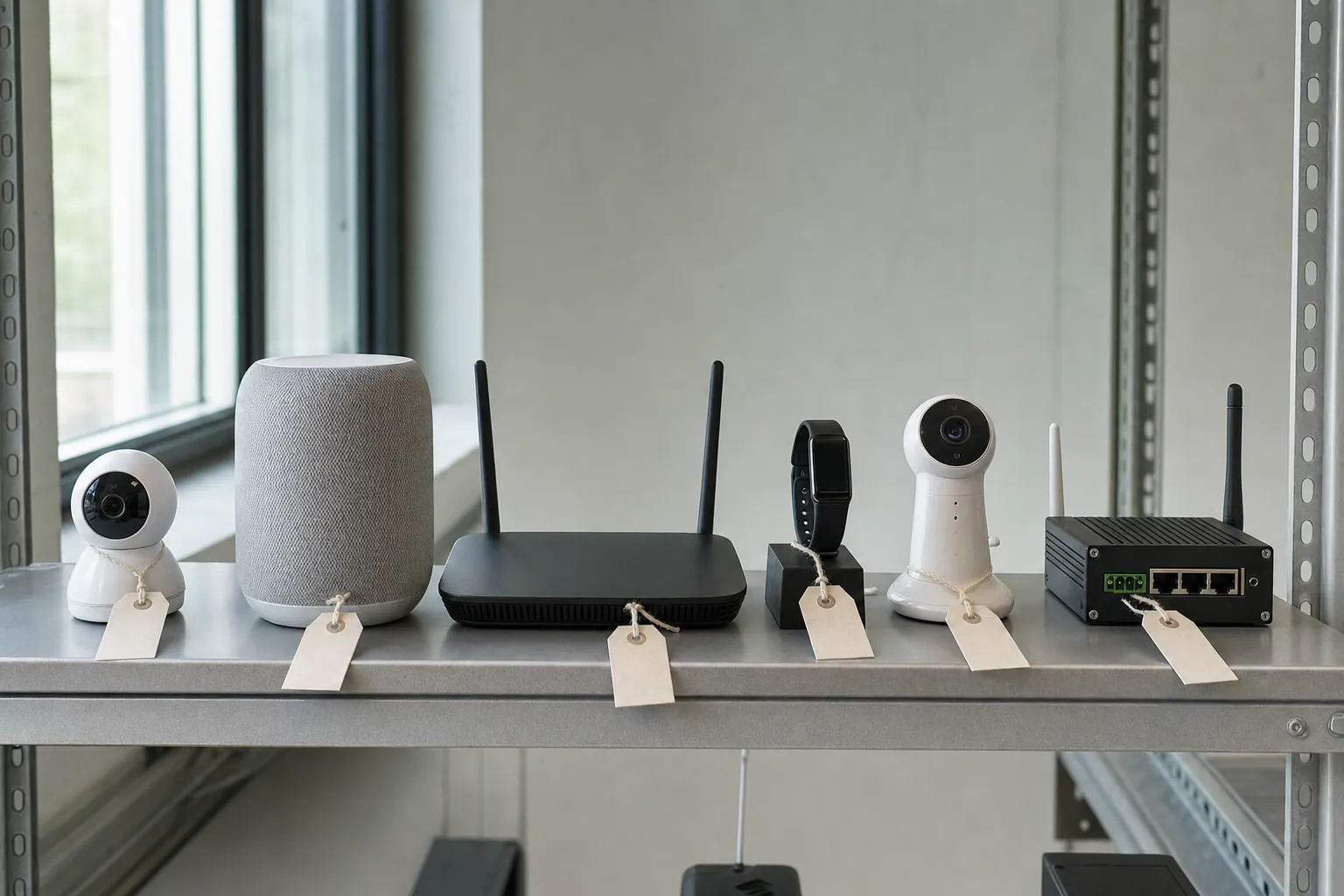
Which category your device falls in
Class follows the product's core functionality, as described in Implementing Regulation (EU) 2025/2392. The Commission describes point 17 as products that protect the physical security of consumers in a residential setting and can be controlled or managed remotely, including the hardware and software that centrally control them.
| Device | Category | Class | Route |
|---|---|---|---|
| Smart door lock, home security camera, baby monitor, alarm system | Smart home security products | I (Annex III, point 17) | Notified body (Module B+C or H), or Module A if harmonised standards are applied in full |
| Hub or app that centrally controls those security products | Smart home security products | I (point 17) | Notified body (Module B+C or H), or Module A if harmonised standards are applied in full |
| Smart speaker or standalone device with a general purpose virtual assistant | Smart home virtual assistants | I (point 16) | Notified body (Module B+C or H), or Module A if harmonised standards are applied in full |
| Connected toy that speaks, films or tracks location | Connected toys | I (point 18) | Notified body (Module B+C or H), or Module A if harmonised standards are applied in full |
| Router or mesh access point sold with the system | Routers, modems and switches | I (point 12) | Notified body (Module B+C or H), or Module A if harmonised standards are applied in full |
| Smart plug, bulb, thermostat or appliance | Not listed in Annex III or IV | Default | Module A self-assessment |
Building a listed component into a device does not by itself move the device into that class (Article 7(1)). A smart display that runs an operating system is not an operating system product, in the same way the Commission says a smartphone is not (Commission guidance, Example 58).
Your app and cloud are part of the product
The CRA covers a product together with its remote data processing solutions (Article 3(1)). Recital 12 gives the smart home case directly: cloud functions a smart home manufacturer provides so users can control the device at a distance fall within the CRA. The Commission adds that software needed to operate, configure or control a device is part of the product even when it comes through an app store (Commission guidance, point 25). Remote control, onboarding, configuration and update distribution are among the functions it lists (point 190). Your app, your device API and your update service therefore sit inside the conformity assessment.
The route for a Class I device
A Class I device can be self-assessed under Module A only if harmonised standards, common specifications or a certification scheme at assurance level "substantial" are applied in full (Article 32(2)). Otherwise it needs a notified body, through EU-type examination (Module B, then C) or full quality assurance (Module H).
No CRA harmonised standard had been cited in the Official Journal as of 23 November 2026. Under the amended standardisation request of 10 November 2026, the standards for the Annex III and IV categories are due by 31 January 2027, so citation before 11 December 2027 is possible but not certain. When we checked NANDO on 23 November 2026, it listed no notified body under the CRA.
The standards body plan assigns the smart home security standard to ETSI. Until standards are cited, plan for a notified body and a lead time before 11 December 2027.
Rules you may already follow
- Radio Equipment DirectiveRadio equipment that can communicate over the internet has had to meet the cybersecurity requirements of Delegated Regulation (EU) 2022/30 since 1 August 2025, with points (e) on personal data also covering childcare equipment, toys and wearables. The harmonised standards EN 18031-1, -2 and -3 are cited with restrictions, including one that removes the presumption of conformity where a user may skip setting a password. Delegated Regulation (EU) 2026/339 repeals 2022/30 from 11 December 2027, when the CRA takes over, and a RED type-examination certificate can be relied on for the risks it covers until 11 June 2028 at the latest (Article 69(1); Commission guidance, points 247 to 249). See CRA vs the RED delegated act.
- ETSI EN 303 645The consumer IoT baseline many smart home makers already use. It is not a CRA harmonised standard, so it gives no presumption of conformity under the CRA on its own. See ETSI EN 303 645.
- US Cyber Trust MarkThe FCC's U.S. Cyber Trust Mark is a voluntary label for wireless consumer IoT products, with a QR code linking to a registry (47 CFR 8.203). The FCC says it will announce when the program is ready to accept applications for products to bear the label; it had not done so by 23 November 2026. It is a separate US program and does not show conformity with the CRA. See CRA vs the Cyber Trust Mark.
What to do first
- Confirm the classMatch each product's core functionality to the official descriptions. Document why, since the class decides the route and authorities can check it.
- Set up reportingArticle 14 has applied since 11 September 2026, including to devices already on sale. Name who files within 24 hours and register on ENISA's Single Reporting Platform.
- Map Annex ISecure by default settings, a reset to original state, security updates with automatic installation as the default where applicable, access control and data minimisation (Annex I, Part I, point 2).
- Plan the third-party stepBudget for a notified body for Class I devices unless standards are cited and applied in full. Check NANDO for bodies notified for your modules.
- Fix the support periodAt least five years unless the device is expected to be used for less, with the end month and year shown at purchase (Article 13(8) and (19)).
Sample scoping sheet
- Digital elements
- Yes. Wi-Fi, phone app and cloud video storageArt. 2(1), 3(1)
- Remote processing
- Live view, alerts and firmware updates run through the maker's cloudArt. 3(2); recital 12
- Category
- Important, Class IAnnex III, point 17
- Route
- Module B+C or Module H, unless harmonised standards are applied in fullArt. 32(2)
- Other EU rules
- Radio Equipment Directive delegated act until 10 December 2027Reg. (EU) 2022/30
- Reporting
- Applies now, through ENISA's Single Reporting PlatformArt. 14, 69(3)
- Support period
- Set by expected use, at least five years, end date shown at purchaseArt. 13(8), 13(19)
Common questions
Is a smart plug an important product?
Not on the face of Annex III. A smart plug does not protect the physical security of a home, so it is in the default category unless its core functionality matches another listed category. It still needs to meet Annex I and can self-assess under Module A.
Does our companion app need its own conformity assessment?
Usually not. Where the app is needed to operate, configure or control the device, the device and the app form one product and are assessed together (Commission guidance, point 25). An app you sell on its own is a separate product.
Can we self-assess a smart lock?
Only if you apply harmonised standards, common specifications or a certification scheme at "substantial" in full (Article 32(2)). None had been cited for the CRA as of November 2026, so plan for a notified body.
Sources
- Regulation (EU) 2024/2847 (Cyber Resilience Act), Official Journal text
- Commission Implementing Regulation (EU) 2025/2392, technical descriptions of important and critical products
- Commission guidance on the application of the CRA, C/2026/6013 (OJ C, 17 November 2026)
- European Commission, CRA reporting obligations
- Commission Delegated Regulation (EU) 2022/30 (cybersecurity requirements for radio equipment)
- Commission Delegated Regulation (EU) 2026/339 (repeal of 2022/30 from 11 December 2027)
- Commission Implementing Decision (EU) 2025/138 (EN 18031 cited with restrictions)
- FCC, U.S. Cyber Trust Mark
- Commission Implementing Decision C(2026) 7861 amending the CRA standardisation request
- CEN, CENELEC and ETSI, M/606 work programme (April 2025), a standards-body plan
- European Commission, Single Market Compliance Space: notified bodies (NANDO)